













Re:Metamorphosis Candina


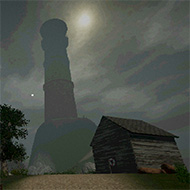
Re:Metamorphosis Candina looks, from the first screenshot, like a moody platformer about two ghost-hunters poking around a haunted ruin. It plays like a spatial logic puzzle wearing a platformer’s controls, where the real obstacle is rarely a pit or a spike trap and almost always a grid you don’t understand how to cross yet.
| Genre | Puzzle-platformer / adventure |
| Perspective | 2D side-scroller |
| Setting | A cursed mausoleum and its labyrinth |
| Controls | Keyboard (movement, jump, interact) |
Farold Roberts, Atzlar, and the Curse at the Heart of Re:Metamorphosis Candina
The setup is simple. Curse investigator Farold Roberts and his winged companion Atzlar arrive at a mausoleum tied to a local legend — a prince buried centuries ago who never settled into the afterlife he was owed. Instead of a quiet grave, the pair finds a shifting labyrinth underneath, and that labyrinth is the entire game.
Atzlar isn’t flavor text in the corner of the screen. He’s present through most of the exploration, reacting to what’s found and occasionally caught up in smaller mishaps, giving the pairing a comic edge against a dark backdrop — the detail players mention first describing the tone of Re:Metamorphosis Candina.
None of this matters if the mechanics don’t hold up, and that’s where the game earns its reputation. The curse isn’t solved through combat but by understanding the labyrinth’s logic well enough to reach the chamber holding the truth.
Building Paths With Panels Instead of Walking Them
The central mechanic isn’t movement, it’s construction. Rooms sit on a grid, and instead of walking a hallway that already connects two chambers, you collect panels and place them to build the path. Some panels connect two adjacent squares; others bend, branch, or dead-end, and figuring out which shape gets you where you’re going is the puzzle in nearly every chamber.
This flips the usual platformer assumption, where the level exists and your job is to survive crossing it. Here the level is inert until assembled, so dying rarely comes from bad reflexes but from committing panels to the wrong layout and realizing too late you can’t finish.
Supply scarcity is deliberate. You’re never handed enough panels to brute-force a solution, so a chamber that eats panels on a dead end can leave you short elsewhere, forcing a walk back to recover pieces you already placed.
Reading Room Codes Like F7 and N3
Every chamber is labeled with a coordinate — F7, N3, M8 — and the labeling isn’t cosmetic. The map marks which coded rooms hold puzzle-critical objects, which are worth a detour, and which are just passthrough space on the way to somewhere that matters more.
New players tend to ignore the coordinate system early on and pay for it later when they can’t recall whether a needed panel was two screens back or four. Cross-referencing the map against coded rooms turns backtracking from guesswork into a second, smaller puzzle.
By the time you’ve mapped a full wing this way, the coordinate system stops feeling like interface and starts feeling like the language Re:Metamorphosis Candina expects you to think in.
The Fountain of Joy, Amazement, Sadness, and Fear
One memorable set piece revolves around a fountain tied to four named emotions — Joy, Amazement, Sadness, and Fear. Activating the right combination has to be inferred from clues in nearby chambers, and getting it wrong just resets progress on that puzzle and asks you to reconsider what you missed.
What sets the fountain apart from the panel-placement puzzles elsewhere is that it’s a pure logic check with no spatial component — no panels, no coordinates, just reasoning through which emotion the history points to. It’s the clearest sign the game varies its puzzle language instead of one trick.
Players who’ve finished the labyrinth mention the fountain specifically when asked what stuck with them, less because it’s the hardest puzzle and more because backstory and mechanics line up perfectly there.
Ghosts, Skeletons, and What They Actually Tell You
The labyrinth isn’t empty. Ghosts and skeletons occupy several coded rooms, and rather than functioning as hazards, most hand you information — a hint toward the fountain sequence, a warning about a room ahead, or a fragment of the prince’s history.
That’s a small but important distinction from games using ghosts purely as threats. Here, an encounter is closer to a dialogue checkpoint, and skipping one is the easiest way to miss a clue the fountain puzzle depends on.
Not every encounter is generous, though — a few hints only make sense retroactively, after you’ve found the answer another way. That’s a fair criticism players raise about a couple of clues.
Secret Rooms and the Reward for Wandering Off the Main Path
Beyond the rooms required to progress, the labyrinth hides secret chambers off the coded route, reachable only if you spend panels on connections that don’t obviously lead anywhere. Completionists hunt these down separately, since a secret found early can hand an easier path to a panel you’d otherwise backtrack for.
Casual players tend to beeline the coded rooms the map flags, a valid way to finish that still means missing content a patient run would surface. Both approaches work, and the labyrinth rewards wandering without punishing directness.
Once you know these spaces exist, a blank stretch between two marked rooms stops looking empty and starts looking like a question the game is daring you to answer.
Precise Jumps and the Controls Re:Metamorphosis Candina Expects You to Master
Movement uses a standard layout — directional keys or A and D to move, Z, K, Up, or W to jump, X or L to interact, Down or S to crouch through lower sections. None of that is unusual, but the platforming demands more precision than the gentle early pace suggests.
Jump timing gets stricter once you’re crossing panel bridges you’ve just placed rather than fixed geometry, since a placed panel doesn’t always give the margin for error a designed platform would. Misjudging a jump doesn’t usually kill you, but it can knock you back onto a panel you’d rather not have wasted.
Players expecting a pure puzzle game sometimes underestimate this layer at first, then adjust once failed jumps make clear it wants platforming competence alongside spatial reasoning, not instead of it.
The High-Five Ending Players Keep Bringing Up
After everything the labyrinth puts you through, the resolution lands on something disarmingly small — Farold and Atzlar sharing a high-five once the curse is dealt with. It comes up constantly whenever the game is discussed, not because it’s mechanically significant, but because it’s the one moment of genuine warmth after a runtime spent underground in silhouette and shadow.
That contrast is deliberate, and it works because the mausoleum never lightens up to match it. The two-color pixel art stays consistent from the first coded room to the last, silhouetted figures against a limited palette, which makes the ending’s small relief land harder.
It’s a well-liked touch, part of why the labyrinth’s reputation has held up among those who’ve finished it.
- How long does it take to finish the labyrinth in Re:Metamorphosis Candina? There’s no official clock, but players describe it as a single solid sitting rather than a sprawling campaign, with the fountain puzzle and later coded rooms accounting for most of the time spent stuck.
- What’s the trick to the fountain puzzle? Treat Joy, Amazement, Sadness, and Fear as clues tied to the mausoleum’s backstory rather than a pattern to guess blindly — the surrounding chambers, and what the ghosts and skeletons mention in passing, point toward the correct sequence if you’ve been listening.
- Is it worth chasing every secret room, or is that just padding? Secret rooms sometimes shortcut a panel route you’d otherwise backtrack for, rewarding completionists directly, but a player focused on the main coded path loses nothing essential by skipping them.
Re:Metamorphosis Candina earns the contrast it sets up at the start — a quiet, two-color mausoleum that looks like a simple platformer and turns out to be a game about reading rooms, panels, and coordinates like F7 or N3 as puzzle pieces rather than a map to walk across. By the time Farold and Atzlar share that last high-five, the labyrinth has made its point about what kind of game it was all along.