

















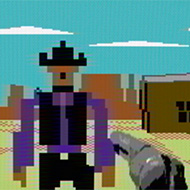
Bad Pixels



Accuracy in Bad Pixels rewards patience more than reflexes, which isn’t what a shooting gallery layout usually promises. You’d expect a crosshair and a row of targets to be all about fast trigger fingers, but the rhythm here punishes anyone who fires without lining up the shot first. That mismatch is the first thing new players notice.
| Genre | Western Shooting Gallery |
| Platform | Browser (HTML5) |
| Perspective | Fixed first-person viewpoint |
| Objective | Score-based target shooting |
The Shooting Gallery Loop in Bad Pixels
The setup is simple: targets appear across a dusty, saloon-adjacent backdrop, you aim, you fire, and a running tally tracks hits versus misses. Bad Pixels doesn’t dress this up with a story — it’s a pure arcade loop, closer to a boardwalk shooting booth than a narrative shooter.
Where the game builds pressure is the pacing between waves. Targets cycle faster the longer a round runs, so the opening seconds feel easy and the closing stretch feels frantic. Players used to twitch shooters tend to overcorrect, spraying shots instead of tracking the pattern, and that’s usually where the score falls apart.
- Targets spawn in short bursts, rewarding players who track multiple points at once.
- Missed shots reduce your accuracy percentage, which matters more than raw hit count.
- Later waves introduce faster or smaller targets, tightening the margin for error.
- A round ends on a timer or after a fixed target count, depending on the mode.
What Bad Pixels Doesn’t Explain Up Front
Regulars bring up how little the game tells you about scoring weight. A clean hit near a target’s center counts for more than a grazing edge hit, but nothing on screen spells that out — you figure it out by comparing runs. Some enjoy discovering the logic themselves; others find the lack of an explicit breakdown frustrating for a game this small.
Casual players treat every round the same and plateau early, while score-chasers who slow their pace in later waves climb the tally fastest. Bad Pixels doesn’t punish either approach directly — it rewards precision over volume regardless.
That brevity keeps the tin-can round format from overstaying its welcome, and it’s a big part of why regulars treat it as a quick warm-up rather than a long session.
Is Bad Pixels multiplayer?
No — every round is a solo attempt against the target pattern and the clock. There’s no shared lobby or competitive tally built into the current version, just your own accuracy percentage against the wave.
How do you get a high score in Bad Pixels?
Prioritize clean center hits over sheer shot count, since edge hits count for less. Slow your pace in the faster, later waves instead of matching the speed shot for shot, and treat every miss as a bigger loss than it looks like on the tally.
Does Bad Pixels have levels or just endless rounds?
Rounds are short, self-contained sessions rather than a level progression, so each attempt resets instead of building toward a campaign. A single tin-can round rarely runs past the two-minute mark before ending on the timer or target count.
Bad Pixels won’t hold your hand about how its scoring works, and that’s fine — once you’ve run the tin-can round a few times, the pattern clicks, and a throwaway shooting gallery turns into a tight test of restraint.