














Tricky Towers




Gravity in Tricky Towers never pauses, not even for the second you spend deciding where a block should land. That fact shapes almost everything else — there’s no idle moment to study the stack, since the piece keeps dropping while you think and the tower keeps leaning while you hesitate.
| Genre | Physics Puzzle / Tower Building |
| Perspective | Side-view 2D |
| Platform | Browser |
| Objective | Stack falling blocks as high as possible without the tower toppling |
Why Every Placement in Tricky Towers Costs You Balance
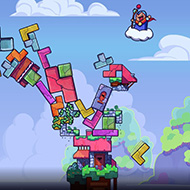
The loop looks simple: blocks fall, you rotate and slide them, and they land on the growing stack. What that hides is that every placement shifts the tower’s center of mass a little, and those shifts add up fast. A block set slightly off-center at row four doesn’t matter alone, but by row twelve that habit has the whole structure leaning hard to one side. Beginners consistently misjudge this, treating each block as an isolated decision instead of asking how it changes everything underneath it. Players with real hours in Tricky Towers think two or three pieces ahead, leaving gaps low in the stack for correcting a bad placement later.
Reading Tilt Before It Becomes a Collapse
A tower about to fall doesn’t collapse out of nowhere — it tilts first, gradually, and the placements right before a collapse are almost always the ones a player rushed. Noticing that lean early, while there’s still room to correct it, is the single most useful habit anyone picks up from repeated runs. The fix isn’t reflexes, it’s checking the base periodically instead of only watching the falling piece.
A short list of what separates an early collapse from a tall, stable tower:
- Dropping a piece flat without checking whether the row underneath is already uneven
- Building straight up the middle instead of widening the base early for room to error
- Ignoring a slight lean because the tower “still looks fine” from a glance
- Rushing a placement near the top instead of slowing down when margin is smallest
Stacking Wide Versus Racing Fast in Tricky Towers
There’s a real trade-off in Tricky Towers between a wide, forgiving base and racing upward for height. A wide base eats blocks that could otherwise add to your score, but it buys stability that pays off many rows later. Racing straight up gets impressive early results and then collapses hard, right when a player was starting to feel confident. Experienced players widen the base just enough to absorb a couple of bad placements, then prioritize height once the tower has slack. Piece shape matters too — long flat pieces correct a lean well, while blocky shapes are more likely to introduce a new wobble.
How Later Rows Punish Early Mistakes
The most divisive thing about this kind of physics stacking is that a small mistake made early can sit dormant for a dozen rows before it finally causes a collapse. Sometimes a tower holds together for a surprisingly long stretch before the accumulated lean from row six finally tips everything at row eighteen. That delay is either the most interesting part of Tricky Towers or the most frustrating, depending on who you ask — it rewards discipline from the first block and punishes anyone who gets sloppy once a run feels safe.
The Moment a Tower Stops Being Recoverable
There’s a specific feeling regulars recognize instantly: the tower leans, you place a correcting block, and instead of settling it, the correction makes things worse. That’s usually the moment a run is over, even if the collapse takes another second to actually happen. Knowing when to stop trying to save a tower and let it fall so you can start fresh is a skill nobody teaches directly, but every regular develops it. The sound and motion of a stack finally giving way, blocks sliding off in every direction at once, only really lands after you’ve caused it yourself a few times.
Does piece shape matter more than where you place it?
Both matter, but placement usually wins. An awkward piece placed carefully against a flat surface causes less lean than an easy piece dropped carelessly onto an uneven row.
Why does my tower fall even when it looks straight?
A tower can look straight from a distance while carrying a lean only visible up close. Small offsets compound as height increases, so a stack that appears fine can already be past the point a normal correction fixes.
Is it better to build slow and careful or fast for height?
Most experienced players favor a careful base followed by faster building once the tower has enough width to tolerate small mistakes. Speed runs look impressive briefly, then collapse before beating a patient stack.
Tricky Towers rewards patience it never explicitly asks for, and that’s the appeal once you’ve fallen for it a few times. The satisfaction of a tower that survives past the point where your last one collapsed is worth every run that ended with the stack sliding sideways off the base.